Evaluating for better decisions: cohousing and cooperative housing models
At Andaira we have spent years exploring how the ways of living condition our quality of life and accompanying the transformation of models. In the context of a housing crisis, the cohousing or collaborative housing emerges not only as a residential alternative, but also as a pilot of the Social and Solidarity Economy.
Following the completion of the Comparative impact assessment of senior living communities in the framework of Communities of Care and l' Study of the impact of cooperative housing in cession of use, For HABICOOP, we seek to reinforce the foundations of a growing model, providing evidence for scaling up public housing policies rooted in sustainability and social justice.
The main objective of these evaluations has been to know the idifferential impact of cohousing and cooperative housing models compared to traditional models (residential or market rent) in people's lives. We want to understand not only whether the model works, but how and why change happens.
Measuring impact
In order to answer the questions posed, both evaluations are based on the measuring the net impact of the housing model using the quasi-experimental method of post-test comparison between groups. A multivariate statistical control of possible intervening variables has been applied, in addition to a bias control including stratified sampling and other data quality control procedures.
In senior cohousing, positive impacts on autonomy, social integration and emotional well-being are identified, while other indicators such as improved physical health or reduced morbidity do not show statistically significant differences compared to other models.
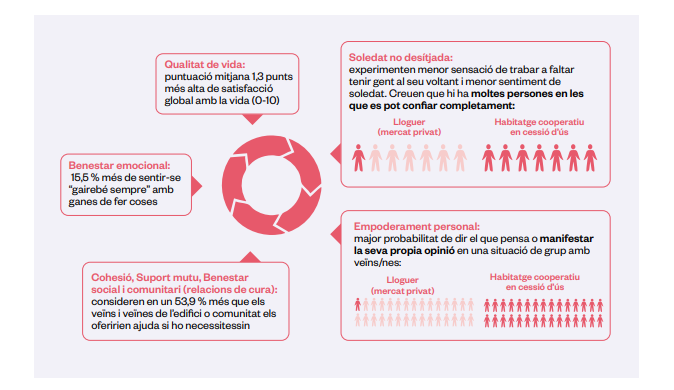
The cooperative housing model also identifies substantial social, environmental and economic impacts, and describes a particularly clear niche of change at the relational level, with positive changes in unwanted loneliness, mutual support and cohesion, linked to emotional well-being (happiness) and quality of life.
The theory of change applied to housing models
A central part of “how we do it” is in the theory of change. The evaluation systemic, theory-of-change oriented explains the causal chain of assumptions that helps to understand how resources and work processes lead, step by step, to results.
This approach has allowed us to understand that, beyond the concrete results, both studies share a common conclusion: the most consistent impacts focus on relational and emotional wellbeing. Living in cooperative housing communities generates measurable impacts on social bonding, which improves well-being, support, autonomy, housing rights and environmental sustainability, but these impacts depend on specific conditions or factors in the functioning of the model such as governance, resources, design, affordability, etc.
When we look at the generation of cohesion and mutual support, the two assessments reinforce each other. In senior cohousing, people find themselves in a more cohesive environment than in residential homes, which is linked to community engagement and cooperative living; and there is evidence of everyday solidarity. In shared use, it highlights how architectural design and shared spaces function as levers: satisfaction with private and communal spaces is linked to comfort and sustainability, and a substantial proportion of people regularly spend time with their neighbours in communal spaces, which permeates participation and governance.
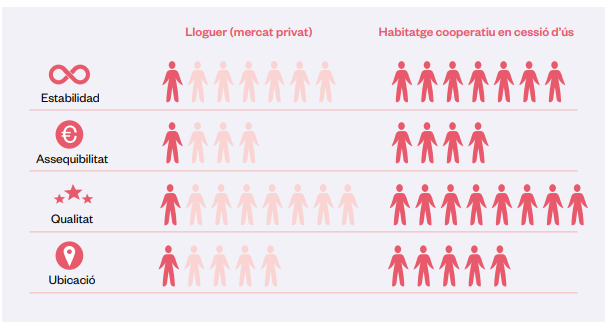
The dimension economic and environmental The data here help to ground debates that often remain in impressions. It is stressed that the model provides security and stability, with economic conditions of access and the possibility of living indefinitely, reducing the usual worries of renting and connecting it with self-determination and the capacity to develop one's own life project.
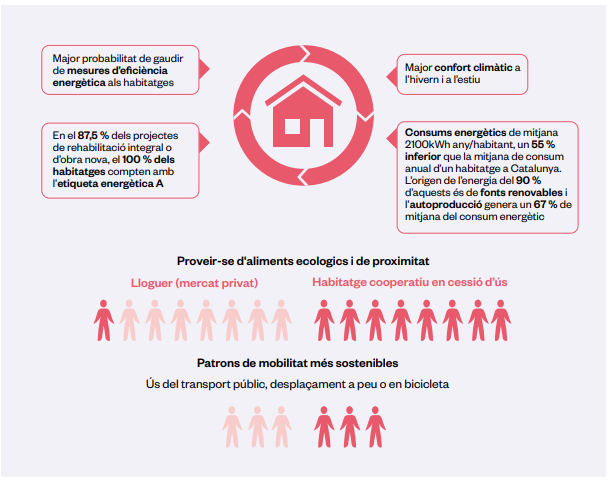
It also describes environmental impacts linked to energy efficiency, climate comfort and water saving, and describes practices such as more sustainable mobility, with an effect that is not only in environmental terms: these practices contribute to reducing expenses and preventing situations of energy poverty, increasing the saving capacity of households.
Housing models from a gender perspective
The gender perspective is not treated as an add-on, but as an integral part of the design of housing communities. On cohousing senior citizens, it is noted that the care is still marked by a strong feminisation and that it is essential to implement strategies to co-care with a gender perspective in order to redistribute responsibilities and avoid reproducing inequalities.
In terms of the transfer of use, it is noted that a proportionally greater presence of women and the inclusion of non-binary people suggests spaces that are more permeable to equitable and inclusive practices and a greater openness to intersectional feminist perspectives in the organisation of everyday life. Likewise, the prominent presence of single-person households within these projects may be an indicator of a greater opportunity for access to housing for profiles that, for economic reasons, could find it difficult to access decent and independent housing in the private market.
Some notes for future evaluations
In the current context of the housing crisis we are going through, the review of housing models is on the rise and there has been an increase in the presence of collaborative housing in recent years. Having models that are growing and expanding is not enough; we need models that demonstrate what they provide, for whom, under what conditions and to better understand the challenges we will face in the future.
When the evaluation with technical and methodological quality It brings into play, contributes to evaluative thinking, provides transparency and transferability, and helps to inform good decision-making about the future scenario we want to move towards.



 Attribution-NonCommercial-ShareAlike